
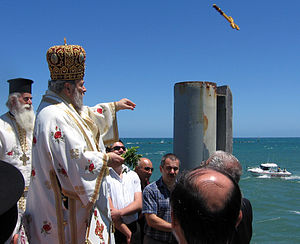
After the morning Divine Liturgy, clergy and members of St. John the Divine Greek Orthodox Church of Wheeling and the Greek Orthodox Church of the Life Giving Fount of Martins Ferry, will celebrate the “Blessing of the Waters” at noon at Heritage Port. The local Orthodox Christian community would like to invite the citizens of the greater Wheeling community to join in this event.
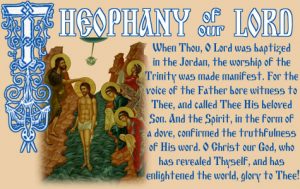
The following explanation of Theophany and the Blessing of the Waters was obtained and adapted from content made available by the Orthodox Church in America’s Series “Lives of the Saints” and the Publication “The Orthodox Faith” written by Protopresbyter Fr. Thomas Hopko. Both are available electronically at www.oca.org/orthodoxy, and Fr. Hopko’s series is also available for purchase at St. Vladimir’s Seminary Press (www.svspress.com).
According to the Orthodox Church in America’s Lives of the Saints series, “Theophany is the Feast which reveals the Most Holy Trinity to the world through the Baptism of the Lord (Mt.3:13-17; Mark 1:9-11; Luke 3:21-22). God the Father spoke from Heaven about the Son, the Son was baptized by Saint John the Forerunner, and the Holy Spirit descended upon the Son in the form of a dove. From ancient times this Feast was called the Day of Illumination and the Feast of Lights, since God is Light and has appeared to illumine ‘those who sat in darkness,’ and ‘in the region of the shadow of death’ (Mt.4:16), and to save the fallen race of mankind by grace.”
“In the ancient Church it was the custom to baptize catechumens at the Vespers of Theophany, so that Baptism also is revealed as the spiritual illumination of mankind. The origin of the Feast of Theophany goes back to Apostolic times, and it is mentioned in The Apostolic Constitutions (Book V:13). From the second century we have the testimony of Saint Clement of Alexandria concerning the celebration of the Baptism of the Lord, and the night vigil before this Feast…”
“…Saint John of Damascus said that the Lord was baptized, not because He Himself had need for cleansing, but to bury human sin by water, to fulfill the Law, to reveal the mystery of the Holy Trinity, and finally, to sanctify the nature of water and to offer us the form and example of Baptism.”
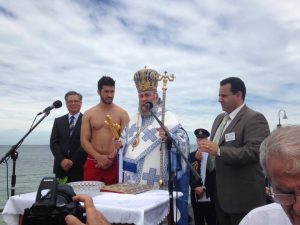
Regarding the Blessing of the Waters, the Rev. Thomas Hopko writes , “We know… that this ritual (of blessing the waters and sprinkling it over everyone and everything) was practiced by the People of God in the Old Testament, and that in the Christian Church it has a very special and important significance.”
Further Fr. Hopko states, “It is the faith of Christians that since the Son of God has taken human flesh and has been immersed in the streams of the Jordan, all matter is sanctified and made pure in Him, purged of its death-dealing qualities inherited from the devil and the wickedness of men. In the Lord’s (Theophany) all creation becomes good again, indeed ‘very good,’ the way that God Himself made it and proclaimed it to be in the beginning when ‘the Spirit of God was moving over the face of the waters’ (Gen 1.2) and when the ‘Breath of Life’ was breathing in man and in everything that God made (Gen 1.30; 2.7).”
Furthermore, “The world and everything in it is indeed ‘very good’ (Gen 1.31) and when it becomes polluted, corrupted and dead, God saves it once more by effecting the ‘new creation’ in Christ, his divine Son and our Lord by the grace of the Holy Spirit (Gal 6.15). This is what is celebrated on (Theophany), particularly in the Great Blessing of Water. The consecration of the waters on this feast places the entire world–through its prime element of watering the perspective of the cosmic creation, sanctification, and glorification of the Kingdom of God in Christ….It tells us that man and the world were indeed created and saved in order to be ‘filled with all the fullness of God’ (Eph 3.19), the ‘fullness of him who fills all in all’ (Eph 1.22). It tells us that Christ, in Who in ‘the whole fullness of deity dwells bodily,’ is and shall be truly ‘all, and in all’ (Col 2.9, 3.11). It tells us as well that the ‘new heavens and the new earth’ which God has promised through His prophets and apostles (Is 66.2; 2 Peter 3.13; Rev 21.1) are truly ‘with us’ already now in the mystery of Christ and His Church.”
Thus, the sanctification and sprinkling of the Theophany water “is the expression of the most central fact of the Christian vision of man, his life and his world. It is the liturgical testimony that the vocation and destiny of creation is to be ‘filled with all the fullness of God’ (Eph 3.19).”